I've never known anyone to discretely categorize their goals. They don't break them down into a system. They have goals, but they don't put them into a systematic order or tag them. Goals are just things that you want to do, and sometimes they're related to personal projects or just things you want to do outside of work.
I noticed the tendency is to label the things you have to do and the things you want to do, but usually those fall inside of work and outside of work. It's very rare to put discrete activities and link them to a particular goal. To go a step deeper and classify your goals and break them into different life goals categories rarely happens.
It happens because we're never trained. We were told goals are goals, and all goals are not created equal. There are different types of goals, but no one distinguishes that. It's not really the way we talk about goals. In achievement theory and a lot of other research, we're talking about motivation. We care about external factors versus intrinsic ones. We hear the terms intrinsic and extrinsic motivation, and these are the things that are surrounding our goals.
Usually, we create goals because we're motivated or unmotivated, or we want to stop something from happening. If you want to get healthy, you want to stop the things and habits that are making you unhealthy, so you have a goal to get healthy. A lot of the goal-setting language is fueled around motivation. But there is a more objective way to approach goal setting that is about categorizing goals, creating specific activities, and understanding the different goal types.
The 5 Categories of Life Goals
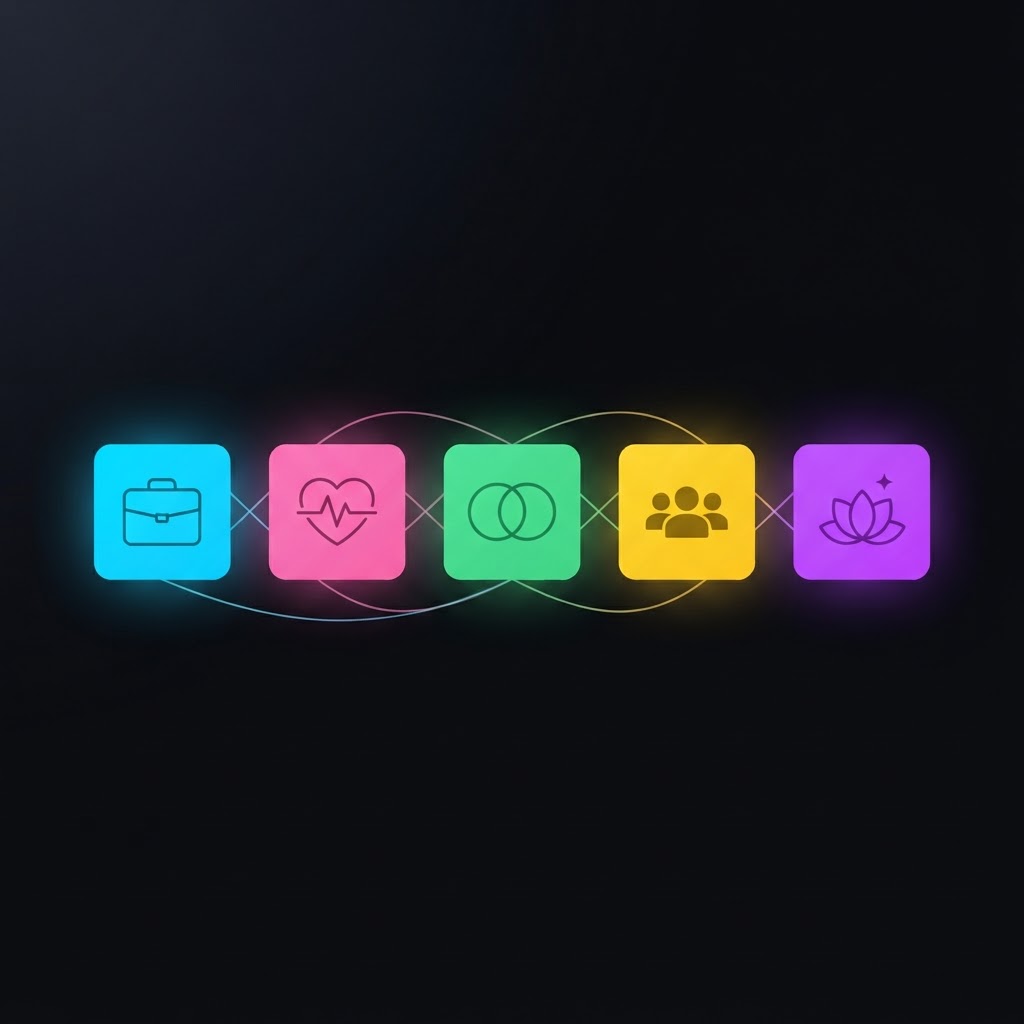
The goal categories, the goal channels, are not hard to understand. They're things that everybody knows and everybody talks about: work, health, community, spirituality, and relationships. All of life can be organized into these categories.
These are just starting points, ways to look at your life. It's helpful to look at them as puzzle pieces and see how the things in your life fit into those puzzles, instead of leaving things in abstract terms. When we put a definition around something, we're closer to understanding it. But sometimes there are things in life we cannot define, and we do have to put constraints. When we put constraints, that helps us engage with life directly. It helps us put tangibles on the intangible.
| Category | What it looks like |
|---|---|
| Work | Your role, your financial success |
| Health | Your body, whether you can actively see you're healthy or not |
| Relationships | The unseen connection you have with your kids and family |
| Community | The unseen connection you have with members of the community |
| Spirituality | The unseen spiritual life that you have |
When we clarify goals in this way, we don't leave things in the abstract, like our relationship goals, community goals, or spiritual goals. Those three areas are a lot of times the unseen, unspoken goals. We feel these effects in our inner dealings.
Why You Miss 3 of Them
It's really the work and health channels that we focus most on because they're visible. Our financial success, the cars and houses. Our physical health: we can actively see if we're healthy or not, if we can use our body, if we're overweight, these kinds of things.
But the unseen things are what drive all of these other outward things. The unseen spiritual life that we have. The unseen connection we have in a relationship with our kids and family. The unseen connection we have with members of the community. These are hard to quantify. But we can make an attempt to make them objective and make objective steps to make them better, and that's through the use of time and being very selective, very specific with how we set goals around these areas.
How to Set Goals in the Unseen Areas
These goal channels are buckets. They're a way to define something. It's up to you how you define what is included. That's going to be based on who you are, what things you like to do. It's a gut intuition that tells you what you should label as what.
For me, I'm a musician, and part of what fills my spiritual bucket, my spiritual activity, is writing, composing, and producing music. Specifically right now, I have a project that I'm working on that is called the Piano Journal. This is where I sit down at my grand piano, I put on some microphones, I hit record, and I start playing. There's no real thought other than to sit down and be in the moment, and this moment of zen is really spiritually fulfilling for me. So this activity fills that cup. I label that as a spiritual activity, and I can set time to that.
Say I'm going to do half an hour of this spiritual activity, and I organize it into my day or my week. Then I've given some specific activity to that goal channel. I'm working and developing it concretely. I'm working on it directly. I'm taking action towards it. I'm not just hoping and wishing that some effect will happen.
It's very similar with relationships and community. You define what activities you pair with those categories. That's what makes it unique and personal to you. The point is to be intentional with what the activity is, be intentional with what you define it as, and then the duration. The time helps, and the time is just there to give you an idea so something can have a beginning and end. Some activities are going to take longer than that, but that's not the point. It's to have some time that you allocate to something very specific so that way you don't lose sight of what's important to you.
The Unseen Areas Are Not Passive
There's overlap and carryover from one dimension of your life, from your spiritual side to your work or to your community. That's something that we don't really talk about: the connection between them. Once you start giving clear activities for all of these five goal channels, they benefit, they sustain each other, because they are connected.
We don't always see how our relationship with our spouse influences us at work. But you would probably agree that if you have a great relationship with your spouse and they're supportive, it's going to make you feel good when you're in your role, when you're presenting, when you're trying to go out there and build your business. It can help you make decisions when you know you have the backing of your relationships. And in the same way, if you have a great role that's able to help you provide for your family, then that's going to help reinforce your relationship.
Society has taught us to value the ones that are seen the most by our community. We're social beings. On social media we project the things that are visible, the social status. It's really hard to qualify the rest. You don't want to say, look how great I'm doing in my spiritual life. Those are private matters. But those private matters drive a lot of the things that you want to do and achieve.
It's not that we neglect them. There's not understanding that we can give them clear, specific intention. Sometimes we think that it's just going to take care of itself. My spiritual cup, my community, those are just kinds of things that happen. But we can engineer change in those areas. We can be proactive, just like we're proactive with landing a new job. We can make change in those areas. Those are not passive areas.
A lot of the time we view those areas as passive. We pray and meditate, for instance, to develop our spiritual side. Or we reflect. For me, I like reading, and I view that as a spiritual activity because it enhances what I know and my reflection, my awareness of the world and what's important. So the more I read, the more spiritual I feel, the more spiritually connected I feel with that type of activity. So you can quantify in this way: when you make time for activities like reading, then you're spending more time in that spiritual goal category. If you're making time for it, that's the point. These areas are not passive. You can have active activities in all of these, and they can enhance that area. They do overlap in time with each other. They are connected.
What Changes When You Categorize Your Goals
The first thing that changes when you sort your goals into life goals categories is that you have more awareness. You can turn this into performance data. You can look at your schedule and it's not just a bunch of Teams invites or meetings for work. You see your daily schedule, when you use a Day Map for instance, you see that you've categorized activities that are important in your spiritual and your community and your relationships. When you do that each day, you can start seeing which areas are driving the best behavior, the best actions, and the best mood that you have.
So it's the way that you enhance your emotions and enhance what's important to you. But obviously you want results, to see what you've done, where you're going, and reflect on that. So this is the way that you work in sprints, you work in intervals. And you cannot just improve if you're not being multidimensional.
This is what you see when you actively put time for your spiritual and community activities alongside your work and relationships: then you start paying attention to everything. You start having more intention around your activity and your time. You appreciate more things.
To summarize: your daily schedule will change. It will be more intentional and more dimensional, from a 360-degree perspective. This gives you more data that you can use to understand yourself better, understand your place in the world, understand how you want to spend your time. This gives you the information so that you can make better decisions. Then you put it in sprints so you're always looking at this information, reevaluating it so you can make better decisions. You can change how you do next week based on what you've learned.
This is how I like to do it. I review every two weeks. I give myself some metrics around what I want to accomplish and then see if it holds up and see if I need to make changes and pivot. And this gives you more data to choose from. It's more dimensional.
Frequently Asked Questions
What are the 5 categories of life goals?
Work, health, community, spirituality, and relationships. All of life can be organized into these categories. They're things that everybody knows and everybody talks about.
Why do you only focus on work and health goals?
Those are the visible channels. Your financial success and your physical health are things you can actively see. The unseen areas, relationships, community, and spirituality, are harder to quantify, but they're what drive all of the other outward things.
How do you set goals in an area like spirituality?
You define what activities fill that bucket for you, based on who you are and what you like to do. Then you allocate time to them, so a specific activity has a beginning and an end, and you're taking direct action instead of hoping and wishing.
Are the five areas of life connected?
Yes. Once you start giving clear activities for all five goal channels, they sustain each other, because they are connected. Your relationship with your spouse influences you at work, and a great role that helps you provide for your family reinforces your relationships.
How often should you review your life goals?
Every two weeks, in sprints. Give yourself some metrics around what you want to accomplish, see if it holds up, and see if you need to make changes and pivot.
Further Reading
- If your life goals stall before they get moving, read Why Most Life Goals Stall (And the System That Gets Them Moving).
- For examples of goals in all five areas, read Life Goals Examples: How to Define What Matters in All 5 Areas.
- On why systems and goals both matter, read Systems vs Goals: Why Atomic Habits Is Only Half Right.
- For the five-channel framework in depth, read Why Whole Life Goal Setting Works When SMART Goals Don't.
- To see how the categories work as a portfolio, read The Activity Portfolio: Why 360° Performers Outperform Specialists.
Helping high-performers unlock their full potential through structured goal systems and intentional daily action.
Level up your performance game
Get weekly insights on goal-setting, daily rituals, and high-performance habits, straight to your inbox. No spam, ever.
Join 1,000+ high-performers. Unsubscribe anytime.
Ready to start? Join SPRY free at sprygoals.com/register.